Why your data should live in a database that's yours alone
Many platforms keep every customer's data in the same database. What that means for your company, and why an isolated database is safer and easier to control.

Juan Daniel Romero Bedoya
Founder & Technical Lead · October 18, 2026 · 6 min read
In short
- In a shared database, the only thing separating your data from another company's is the application code.
- With your own database, a failure affecting another customer cannot expose or affect your data.
- It also makes backups, exports and GDPR deletion requests simpler.
Where your data is when you use a platform
When you sign up for a cloud application (a CRM, a booking tool, a case management system), your data is stored in a database. The question almost nobody asks is: is that database yours alone, or do you share it with every other customer?
On most platforms the answer is the second one. It is called a shared multi-tenant model: every company in the same database, with each row tagged with its owner’s identifier.
How a shared database works
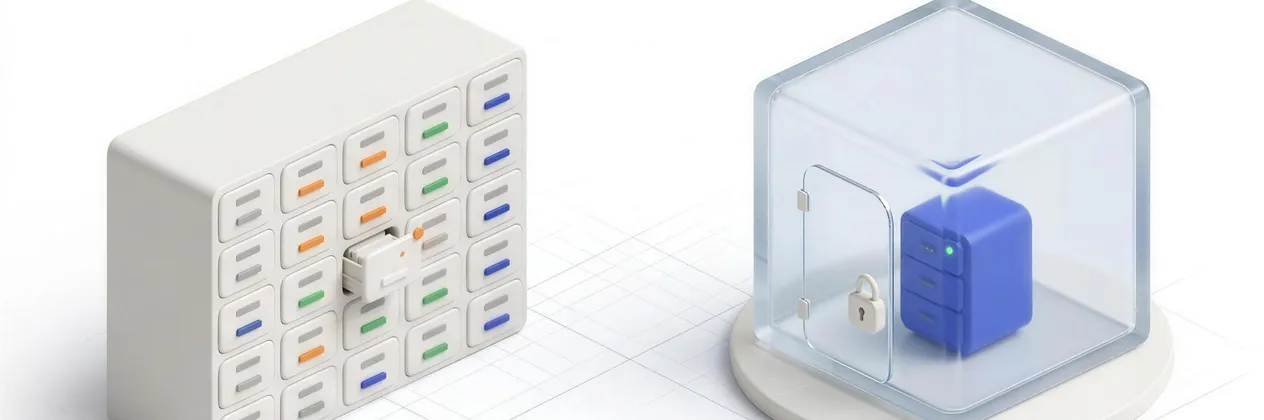
Picture a huge filing cabinet where every company has its folders with a label. What stops one company from seeing another’s folders is that the application filters by that label every time it looks something up.
It is a cheap and efficient model for the provider. But it has an important consequence: the only thing separating your data from another company’s is the code never making a mistake.
“In a shared database, a single forgotten filter is enough to show one customer’s data to another.”
The risks of sharing
- Leaks caused by programming errors. If a query is missing the customer filter, one company can see another’s data. No attack is needed: one bug is enough.
- Another customer’s problem affects you. If another company generates a huge load or suffers an incident, the database is the same for everyone.
- Mixed backups. Restoring only your data to a specific point in time is complicated when it is intertwined with hundreds of other companies’.
- Exporting or deleting is harder. When you ask for your data or for its erasure (a right granted by the GDPR), it has to be separated row by row from everyone else’s.
What changes with an isolated database
In the isolated model, each company has its own database. To continue the example, it is no longer a folder in a shared cabinet: it is your own cabinet, in your own room.
- A failure at another customer does not reach your data. It is not in the same place, so there is no filter to forget.
- Your own performance. Other companies’ activity does not compete with yours.
- Clean backups and restores. Your database is backed up and restored as a whole, without touching anyone else’s.
- Exporting or deleting is immediate. Your data is together: it is handed over or erased in one go.
- Easier to explain in an audit. You can say exactly where your data is and who has access to it.
Isn’t it more expensive?
It is somewhat more expensive for the provider, which is why many platforms do not offer it. But today’s cloud infrastructure makes it possible to create and maintain separate databases automatically, at a reasonable cost.
The level of isolation can also be matched to how sensitive each piece of data is: the more personal or critical, the more separated. Not everything needs the same treatment, but your customers’ data deserves the highest.
Questions to ask your provider
If you already use a platform, these questions will tell you where you stand:
- Is my data in its own database or shared with other customers?
- In which country and data centre is it stored?
- How often are backups taken and where are they kept?
- Can you restore only my data to a specific point in time?
- If I leave, how and in what format do you hand over my data? How do you confirm it has been deleted?
If the answers are not clear, that is an answer in itself.
In short
A shared database is not necessarily insecure, but it makes the protection of your data depend on the code never failing. A database that is yours alone removes that risk at the root and simplifies backups, exports and GDPR compliance. That is why at Squarkio every customer has their own.

Written by
Juan Daniel Romero Bedoya